

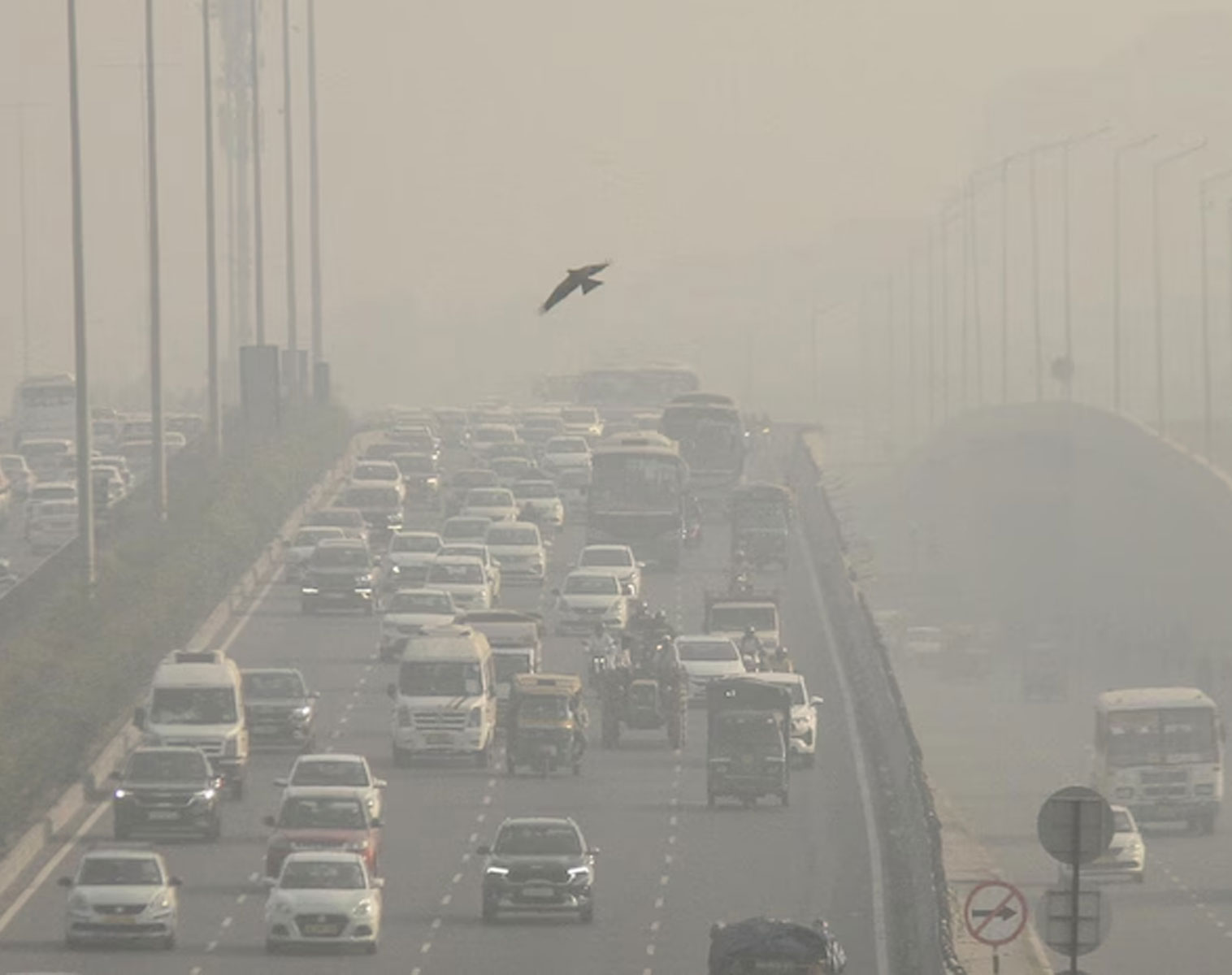
A thick layer of toxic smog cloaked much of northern India on Monday, driving air quality readings in the capital, New Delhi, to their most hazardous levels this year. The severe pollution followed dense overnight fog, compounding public health risks and clouding visibility in several major cities.
This seasonal smog, a toxic blend of smoke and fog, recurs each winter as cold air traps pollutants, including vehicle emissions, industrial outputs, and smoke from illegal agricultural fires in nearby states. This year, visibility dropped to just 100 meters (109 yards) in cities such as New Delhi and Chandigarh, although flight and train operations persisted with some delays.
The national pollution control authority reported that Delhi’s 24-hour Air Quality Index (AQI) reached 484, classified as “severe plus,” the highest in 2024. Live data from Swiss air quality monitoring firm IQAir ranked New Delhi as the most polluted city globally, with AQI levels hitting a “hazardous” 1,081. The PM2.5 concentration — fine particulate matter small enough to penetrate the lungs and cause serious health issues — was measured at 130.9 times the World Health Organization’s recommended safe levels.
Experts note that AQI figures can vary internationally due to differing scales used to assess pollutant concentration, which may lead to disparities in reported severity.
In response to the crisis, authorities in Delhi mandated schools to shift to online learning and imposed stricter limits on construction projects and vehicle traffic, citing unfavorable weather conditions and weak wind speeds that exacerbate pollution levels.
Contributing up to 40% of the air contamination in Delhi are farm fires, where residual stubble from rice harvests is incinerated to clear fields for the next planting cycle. On Sunday alone, satellite data captured 1,334 such fires across six states, marking the highest count in recent days, according to the Consortium for Research on Agroecosystem Monitoring and Modeling from Space.
Despite the dense smog and health warnings, life continued for many residents, who navigated streets shrouded in a gray haze. Key landmarks, such as the historic India Gate, were barely visible. “Morning walk usually feels good, but now the air is polluted, and we’re forced to wear a mask… There is a burning sensation in the eyes and slight difficulty in breathing,” shared Akshay Pathak, a local resident, in an interview with ANI news agency.
The Indian Meteorological Department has forecasted “dense to very dense fog” for the states of Uttar Pradesh, Haryana, and Rajasthan, further compounding public health concerns in the coming days.