

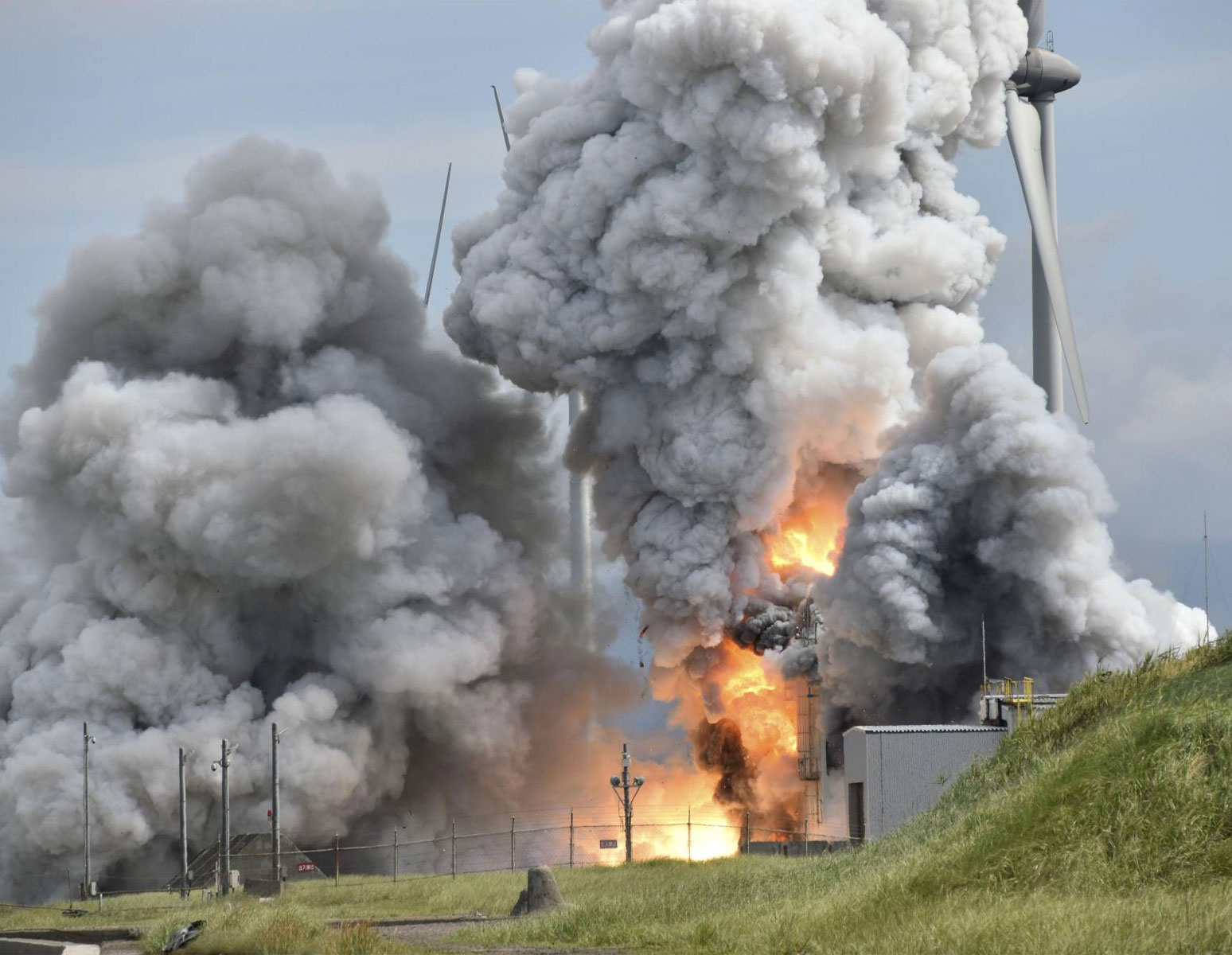
Tanegashima, Japan – A dramatic fire erupted at the Tanegashima Space Center during an engine test for Japan’s Epsilon S rocket on Tuesday, forcing the Japan Aerospace Exploration Agency (JAXA) to abort the operation.
“There was an abnormality during today’s combustion test. We are trying to assess what happened,” JAXA stated after the incident.
Footage broadcast by NHK captured flames and thick smoke billowing from the site, located on Japan’s southern island of Tanegashima. Witnesses, positioned about a kilometer away, reported hearing a significant explosion shortly after the test commenced at 8:30 a.m. local time (2330 GMT).
No Injuries, Cause Under Investigation
Thankfully, no injuries have been reported. JAXA and government officials have pledged a thorough investigation into the incident.
“JAXA will conduct a thorough investigation into the cause of the problem and consider countermeasures,” said Chief Cabinet Secretary Yoshimasa Hayashi. He emphasized the critical role flagship rockets play in maintaining Japan’s independence in space exploration.
Epsilon S Launch Timeline in Doubt
The fire casts a shadow over the timeline for launching the Epsilon S rocket, initially slated for March 2025. The Asahi Shimbun newspaper speculated that meeting this deadline would now be “practically impossible.”
The Epsilon S is designed as a successor to the Epsilon rocket, a compact and cost-effective model aimed at launching small satellites.
Broader Setbacks for Japan’s Space Program
This incident adds to recent challenges for Japan’s space program. In March, a privately developed rocket by Tokyo-based Space One exploded seconds after takeoff. Additionally, the development of the H3 rocket system, envisioned as Japan’s next-generation workhorse, has faced repeated delays and setbacks.
Japan’s space ambitions remain crucial to its technological and scientific goals, but recent failures highlight the difficulties of maintaining a competitive edge in the global space race.