

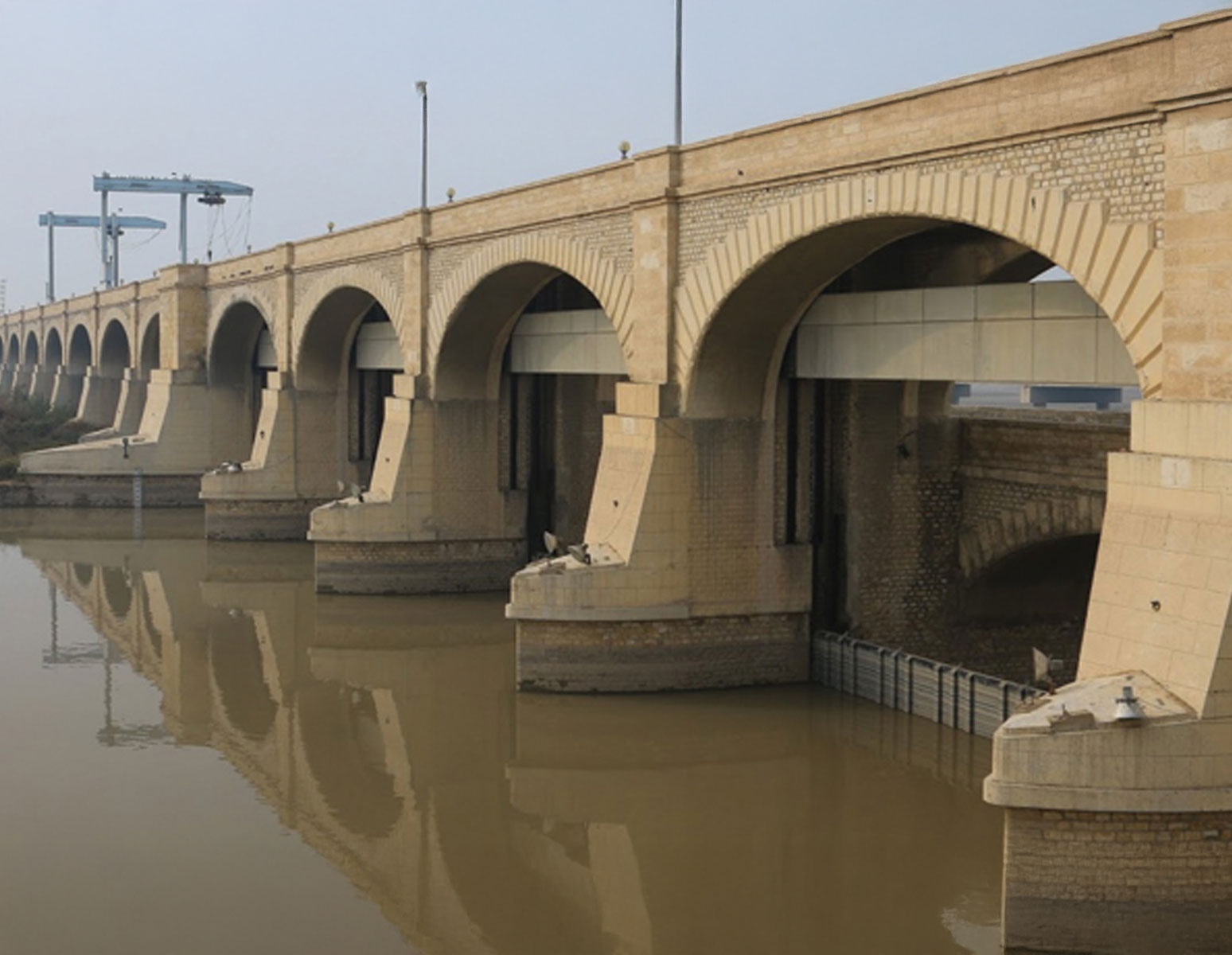
A significant phase of the ongoing upgrade of the colonial-era Sukkur Barrage is set to be completed before the 2025 flood season, with the replacement of 18 gates under a World Bank-funded loan. This critical work is part of the broader Sindh Barrages Improvement Project (SBIP), aimed at modernising both Sukkur and Guddu barrages—vital structures on the Indus River.
Out of the Rs74.6 billion World Bank loan, Sukkur Barrage is receiving Rs43.3 billion, while Guddu Barrage is allocated Rs31.3 billion. Progress at Guddu Barrage has reached 63%, whereas Sukkur Barrage lags behind at 21% due to a delayed start.
Engineering Overhaul Underway
The Sukkur Barrage, a century-old marvel of Pakistan’s irrigation system, plays a crucial role in Sindh’s agrarian economy, feeding both lower and upper districts through major canals like Nara and Rohri on the left bank, and Rice and Dadu canals on the right bank. The North Western Canal also supplies water to Balochistan under the Water Apportionment Accord of 1991.
According to project officials, 16 gates (44-59) and two left-pocket gates (62-63) will be replaced by May 2025, just before the flood season begins in May-June. A cofferdam has been constructed to facilitate the replacement, and old gates—previously 21 feet high—are being replaced with 23-foot-high gates featuring an additional horizontal girder for extra strength.
“The cofferdam will be removed by early June 2025 to expose the barrage floor for assessment,” said Pritam Das, Project Director of SBIP. This will mark the first large-scale examination of the barrage floor since its construction in 1932.
Challenges and Historical Context
The Sukkur Barrage was originally designed to handle 1.5 million cusecs, but its capacity was reduced to 0.9 million cusecs due to silt accumulation, leading to the closure of 10 gates (60-66) between 1938-1940. A World Bank-funded study in France is currently exploring the possibility of reopening these gates to restore full capacity.
The barrage has historically faced massive flood discharges, with water flows between 0.8 to 1.2 million cusecs recorded from 1955 to 2010. The devastating 2010 super flood, which saw 1.13 million cusecs upstream, caused the infamous Tori dyke breach, displacing thousands in Sindh.
Gates Replacement and Security Measures
Currently, Chinese engineers are overseeing the replacement of 18 gates, which are being manufactured in China and assembled in Sindh under tight security. The project was accelerated after major damages to seven gates (44-48 and 52-54) on June 20, 2024, including the complete washing away of Gate-47.
This is the third major structural damage to the barrage since 1932. In 1982, Gate-31 collapsed and was replaced by a previously closed gate. Between 1987-1992, all 56 gates were replaced for the first time. More recently, Karachi Shipyard and Engineering Works replaced six gates (31, 33, 34, 35, 39, and 40) between 2021-2022.
A trial run of Gate-36, manufactured by a Chinese firm, began in June 2024 as part of ongoing testing.
Looking Ahead
Experts emphasize that Sukkur Barrage requires a comprehensive study of the Indus River’s flow, covering at least 5km upstream and downstream, to address silt accumulation and pressure points. “The Ultra Jagir dyke causes backwater curves that trap silt, narrowing the river’s path and increasing pressure on the barrage,” noted Sattar Sario, a retired irrigation engineer.
Despite delays and challenges, the Sindh government remains committed to completing the barrage’s modernisation within three years, with all 56 gates eventually being replaced. Whether the 10 closed gates will be reopened will depend on the results of the ongoing French study.
As Pakistan prepares for the 2025 flood season, the upgraded Sukkur Barrage is expected to enhance flood management, irrigation efficiency, and structural resilience, ensuring sustainable water distribution for Sindh and Balochistan.